- Auto Tinting
- Auto Wrapping
- Car Paint Protection
- Tesla
- Residential Tinting
- Commercial Graphics
- Commercial Tinting
- About Us

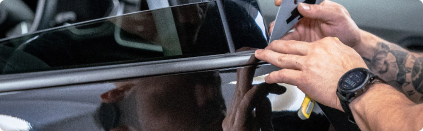











Your car can look the same from the outside and still feel totally different inside. That’s what tint does. It’s not just “dark glass.” It’s heat control, glare control, and protection for your seats and dash. The two big choices people compare are ceramic tint and metallic tint. Ceramic is usually the better film overall, but metallic (and newer hybrid metallic) still has a place – especially when you want strong performance for less money.
If you want the safest “no regrets” pick, go ceramic. It’s better for hot days, clearer to look through, and it won’t mess with your electronics. Metallic can still be a smart buy if you want good heat reflection and durability on a budget – just understand the trade-offs.
How Each Film Works?
Metallic tint is a mirror that reflects the solar energy on the glass using a thin layer of metal. Think “sun bounce.” It is that reflective layer that makes metallic films feel cooler than the simple dyed tint, particularly when your car is parked outside.
The metallic tint of the old school was also known to interfere with signals. This is why the current versions attempt to address it. E.g., XPEL PRIME HP is a layered film that is a hybrid of dyed metal, and XPEL claims that it is designed in such a way that it does not disrupt radio, cellular, or Bluetooth signals, although it contains a metalized layer.
Ceramic tint involves ceramic particles that are non-metal and which are used to block heat (particularly, infrared, IR). It is not attempting to reflect the sun; it is attempting to prevent the heat from entering. Ceramic is naturally signal-friendly since it is not metal, and most quality ceramic films retain a clean and neutral appearance.
Heat, UV, and Glare (What You Actually Feel)
Both ceramic and metallic tint can block most UV (many premium films advertise around 99% UV protection). The bigger difference is heat.
- Ceramic usually wins on IR heat control, so the cabin feels calmer on sunny days.
- Metallic can still do a good job because it reflects energy, but the performance depends heavily on the exact film and shade.
Glare is mostly about VLT (how much light the film lets through). A darker film cuts more glare, whether it’s ceramic or metallic. So don’t assume “ceramic = darker.” It’s more like “ceramic = better heat blocking at the same darkness.”
Electronics and the EV Angle
Signal issues are the biggest fear with metallic tint. And yes – many automakers have removed AM radio from some EVs, partly because EV hardware can create interference that makes AM reception tough. If your EV doesn’t even have AM, that one specific worry matters less.
But you still use GPS, cell data, Bluetooth, and key fobs. That’s why ceramic is still the safer choice when you want zero headaches – and why modern hybrid metallic films (like PRIME HP) try hard to stay compatible.
Looks and Visibility
Ceramic tint usually looks more “factory” from the driver seat. It tends to keep a neutral color, and high-end ceramic has less low-angle haze at night. Metallic films can look a little more reflective from the outside, depending on the film, and that extra reflectivity is either a plus or a deal-breaker for you. Some people like the sharper, glassy look. Others hate any shine.
Also, don’t blame the film type for night driving problems right away. Most of that comes down to VLT (how dark you go). A 20% film is going to feel darker at night than a 35%, no matter what it’s made of.
Real Performance Numbers
| Film | Type | TSER (heat) | IRER (780–2500nm) |
|---|---|---|---|
| XPEL PRIME HP Black 35 | hybrid dyed-metal | 49% | 25% |
| 3M Ceramic IR 35 | ceramic | 58% | 67% |
That’s why ceramic usually feels better in the sun: you’re getting a bigger jump in infrared control without needing the window to be darker.
Durability and Why Metallic Still Exists
Metallic (and hybrid metallic) tint didn’t stick around by accident. It’s popular because it can give you solid heat reflection and a durable finish for less money than premium ceramic. Modern metallic/hybrid films are also not the old-school “mirror tint” people remember.
When Metallic can Make Sense, and When Ceramic is the Better Pick
Metallic / hybrid metallic can make sense if:
- You want a lower price but still better performance than basic dyed tint.
- You mostly care about rear privacy and daytime comfort.
- You’re okay with a slightly more reflective look.
Ceramic is usually the better choice if:
- Your car sits outside a lot and you want the coolest cabin.
- You drive long hours and hate heat fatigue.
- You want the best clarity and the least chance of signal headaches.
Ask us anything.
We’re always in touch.
 Send a message
 Send a message
Conclusion
If you want one answer that fits most drivers: go ceramic. It’s the top performer for heat control, it stays clear, and it plays nice with electronics. Still, metallic and hybrid metallic films remain available as they can deliver a good performance, particularly when you opt to buy a modern hybrid, which lessens interference. But looking at the real figures, it is clear that the ceramic is better in the most crucial aspects: it is more comfortable on sunny days, has better visibility, and has fewer unpleasant surprises after installation.